
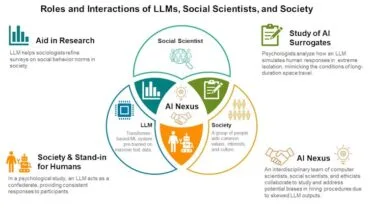
In the world of social research, data isn't always measured in numbers. Often, it consists of interviews, focus groups, open surveys, diaries, or texts that recount experiences. This type of information, known as "qualitative," demands a different approach: more interpretive, closer to the human context. Today, artificial intelligence (AI) is transforming how we manage, analyze, and understand these materials, without losing sight of the human element.
🤖 What can AI do in qualitative analysis?
With AI tools, researchers can:
-
Processing large volumes of qualitative data (numerous interviews, open-ended responses) in significantly less time than before. For example, studies show that machine-assisted topic analysis (MATA) methods achieved results very similar to manual analysis, with significant time savings. (PMC+2Delve+2).
-
Identifying hidden themes, patterns, feelings, or relationships in texts using natural language processing (NLP) (looppanel.com+2BioMed Central+2).
-
Automating operational tasks such as transcribing interviews, initial classification of fragments, or coding suggestions, leaving the researcher more room for interpretation, reflection, and further exploration (heymarvin.com+1).
But it is important to emphasize: AI does not replace the researcher. In qualitative analysis, context, sensitivity to language, the researcher's position, and interpretive reflection remain indispensable.insidehighered.com).
🛠 Specific applications for social research
Some examples of how it is applied in the field:
-
In qualitative health studies, AI tools have been used to analyze dozens of interviews and quickly generate thematic summaries, then compared with human analysis (annfammed.org+1).
-
Specialized platforms allow you to import texts, automatically generate suggestions for “codes” or “themes,” then researchers refine them, grouping and building narratives (ScienceDirect).
-
In the field of education, AI can help analyze open-ended student responses, identify barriers, recurring attitudes, or changes in perception, providing input to improve programs or policies.
⚠️ Ethical and methodological challenges we must consider
Although AI opens many doors, we must not ignore the challenges:
-
Qualitative data often has nuances, ambiguities, and cultural context that AI can misinterpret if it is not well designed or supervised.
-
It is key to guarantee the transparencyHow did the AI come to suggest those topics? What was its logic? This traceability is vital in rigorous research.
-
There is also the question of the positionalityIn qualitative research, the researcher (their background, perspective, relationship with the participants) carries weight. AI, on the other hand, lacks this subjective dimension, which can reduce depth if used without reflection.insidehighered.com).
-
Finally: ethics and privacy. Qualitative data can contain sensitive information (testimonials, personal narratives), so the use of AI requires extra care in protection, anonymization, and consent.
🌱 Looking ahead: a human-AI synergy
At EdukIΔ, we see AI as a strategic collaborator In qualitative analysis, it helps us quickly gather input, explore paths, and suggest connections we might not see at first glance. But constructing meaning—the interpretation that connects the data with its social, educational, and human implications—remains the researcher's job.
To take advantage of this synergy, we suggest:
-
Start with a small pilot: analyze a subset of data with AI, reflect on what it suggests, then scale up.
-
Stay in control: review the automated results, adjust the codes, add your critical voice.
-
Document every step: what data came in, what adjustments you made, how you interpreted it.
-
Make AI-human collaboration explicit in your reports: this strengthens methodological transparency.
-
Finally, don't forget that the heart of qualitative research is understanding human experiences, contexts, and meanings. AI can help you see further; you are the one who gives meaning.